

Ethnic Blepharoplasty
- Internationally recognised facial plastic surgeon.
- Dr De Silva uses precise, ethnic-specific techniques.
- Dr De Silva prioritises patient safety above all else.
Understanding Ethnic Eyelid Surgery
Ethnic Blepharoplasty, also known as ethnic eyelid surgery, is a highly specialised procedure designed to rejuvenate the eyelids of patients from diverse ethnic backgrounds without altering their natural identity.
Unlike traditional approaches to this surgery, the procedure takes into account the specific anatomical features of Middle Eastern, Asian, South Asian, Afro-Caribbean, and Mediterranean eyelids. Differences in skin thickness, fat distribution, eyelid crease formation, and underlying bone structure all influence how the eyes appear and how surgery should be performed.
Dr Julian De Silva, based in Harley Street, Central London, is internationally recognised for performing scarless eyelid surgery that achieves natural-looking results while respecting each patient’s cultural heritage.


How Eyelid Anatomy Differs by Ethnicity
Each ethnic group presents variations in skin elasticity, crease formation, and orbital structure. Understanding these subtleties is essential to achieving seamless, scarless, and natural-looking outcomes.
Dr De Silva has many patients of ethnic descent who request eyelid surgery in London, the most popular destination in the world for Middle Eastern patients to have this cosmetic surgery.
Asian Patients
Asian patients often seek double eyelid creation, designed to surgically create an eyelid crease that has previously been covered beneath epicanthal folds. Dr De Silva refines the eyelid crease to enhance definition while maintaining the characteristic softness of the Asian eye shape.
Middle Eastern Patients
Middle Eastern eyelid surgery patients frequently present with thicker eyelid skin and prominent under-eye bags. Surgery focuses on smooth, rejuvenated contours while preserving their natural ethnic features and avoiding an overly “operated” look.
South Asian Patients
South Asian patients may exhibit skin laxity, pigmentation, or mild puffiness around the eyes. Dr De Silva uses precise, delicate techniques to refresh the eyelids while respecting their ethnic anatomy and overall facial balance.
Afro-Caribbean Patients
Afro-Caribbean patients have a higher risk of keloid or hypertrophic scarring, so Dr De Silva employs advanced scarless transconjunctival techniques and careful tissue handling to minimise visible scarring and achieve natural results.
Mediterranean Patients
Mediterranean patients often seek subtle eyelid rejuvenation, addressing puffiness or heaviness while maintaining their strong, defined features. Dr De Silva’s approach balances aesthetic enhancement with preservation of ethnic identity and natural facial harmony.
The Importance of Choosing a Surgeon Skilled in Ethnic Eyelid Surgery
Ethnic blepharoplasty is a highly complex procedure that demands a refined understanding of heritage-specific anatomical differences. Dr Julian De Silva is internationally recognised, having performed thousands of successful ethnic procedures for patients from across the globe. He is also a Fellow of the Royal College of Surgeons with extensive Harley Street experience. Many patients seek reassurance that surgery will not ‘Westernise’ their eyes.
By taking a comprehensive view, looking at the entire periorbital area instead of just the eyelid itself, Dr De Silva avoids common pitfalls associated with traditional surgery, such as hollowing, high-riding creases, or the development of multiple folds, which can detract from the eyelid’s natural appearance instead of celebrating the patient’s heritage. Variations in skin thickness, eyelid crease formation, fat distribution, and bone structure mean that a one-size-fits-all approach can compromise results.
Ethnic Patients: See Before & After Gallery
View real patient transformations demonstrating natural, ethnic-specific results.
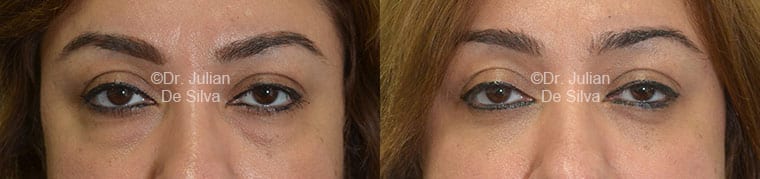
This Asian doctor had noticed an increasingly tired appearance as a consequence of facial ageing around her eyelids with lower eyelid swelling/bags. She had become fed up of people commenting on whether she was tired or had lack of sleep. She came to see Dr De Silva as a specialist in facial plastic surgery, and underwent lower blepharoplasty (hidden incision) with laser skin resurfacing. The result shown 5-weeks after surgery shows a refreshed more youthful appearance, yet natural with no signs of surgery. The patient was very happy with the results of her surgery.
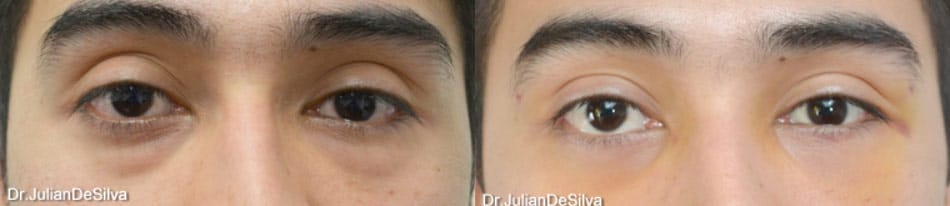
This young Asian man in his late 20s described increased bags in the lower eyelids, which been present for a number of years and resulted in a tired appearance. Lower eyelid bags in this younger person was a result of the anatomical position of his eyelids in a relatively forward position in relation to his cheek, referred to as negative vector.
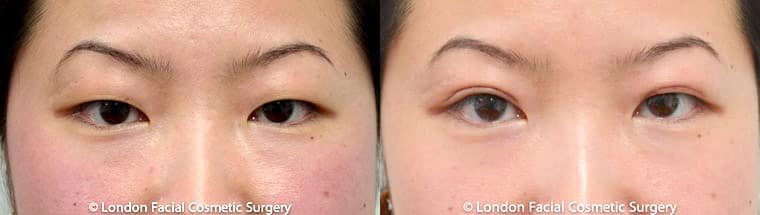
This woman in her 20s was looking to have Asian blepharoplasty with cosmetic surgery to create an eyelid crease. On examination she had complete absence of upper eyelid crease and she wanted a natural looking and conservative improvement in her appearance. Dr De Silva completed an Asian blepharoplasty with the trans-cutaneous approach resulting in a long-lasting and natural result. On review of the ‘after’ photograph there is a symmetrical and clear upper eyelid crease that looks natural and make the eyes appear more open. The patient was very happy with the result and had a natural looking improvement of her appearance.
This Asian doctor had noticed an increasingly tired appearance as a consequence of facial ageing around her eyelids with lower eyelid swelling/bags. She had become fed up of people commenting on whether she was tired or had lack of sleep. She came to see Dr De Silva as a specialist in facial plastic surgery, and underwent lower blepharoplasty (hidden incision) with laser skin resurfacing. The result shown 5-weeks after surgery shows a refreshed more youthful appearance, yet natural with no signs of surgery. The patient was very happy with the results of her surgery.
This young Asian man in his late 20s described increased bags in the lower eyelids, which been present for a number of years and resulted in a tired appearance. Lower eyelid bags in this younger person was a result of the anatomical position of his eyelids in a relatively forward position in relation to his cheek, referred to as negative vector.
This woman in her 20s was looking to have Asian blepharoplasty with cosmetic surgery to create an eyelid crease. On examination she had complete absence of upper eyelid crease and she wanted a natural looking and conservative improvement in her appearance. Dr De Silva completed an Asian blepharoplasty with the trans-cutaneous approach resulting in a long-lasting and natural result. On review of the ‘after’ photograph there is a symmetrical and clear upper eyelid crease that looks natural and make the eyes appear more open. The patient was very happy with the result and had a natural looking improvement of her appearance.
What our satisfied clients are saying
Having Lower Blepharoplasty with Dr. De Silva gives you the benefit of years of experience, qualifications not only in the U.K. but also the U.S. and yet you don’t lose the gentle bedside manner from this doctor. From our first meeting, Dr. De Silva won me over because he gave me the time to obtain answers and explanations to all my questions in kind details, as many times as I needed.

Preserving Ethnic Identity While Enhancing Appearance
The most common concern for ethnic patients is: “Will I lose my cultural features?”
Dr De Silva’s philosophy is simple: enhance, don’t alter. Using advanced, ethnic-specific techniques, he carefully evaluates:
- Skin thickness and elasticity
- Eyelid fat and muscle distribution
- Underlying bone structure
This ensures that rejuvenation is harmonious and natural, giving refreshed, youthful eyes without changing the features that define your heritage.
Recovery Considerations for Ethnic Patients
Recovery after surgery can vary depending on the individual and the techniques used, but generally follows the same process as the main Blepharoplasty procedure. Special attention is given to patients with darker skin tones to reduce the risk of keloid scarring, using scarless transconjunctival approaches whenever possible.
Discover the Real Patient Recovery Experience
Patients often find that recovery is smoother than expected thanks to Dr De Silva’s customised surgical approach and comprehensive aftercare.
What Are the Risks?
For Dr Julian De Silva, patient safety is always the top priority and he has been an advocate for this in the national media. He carefully assesses whether surgery is the right choice for each individual and will only proceed when it can be performed safely. Most risks are similar to those experience during a normal eyelid prodecure. However, for patients with darker skin tones, there is a higher risk of keloid or hypertrophic scarring, as well as potential pigmentation changes.
Frequently Asked Questions
Will I lose my ethnic features?
Will I lose my ethnic features?
This is the most common concern for patients of any ethnic background considering eyelid surgery, and it is entirely understandable. The honest answer is no, not when the procedure is performed by a surgeon with genuine expertise in ethnic eyelid anatomy.
Dr De Silva's approach is guided by your individual features, your cultural identity and your personal goals and not by a Westernised aesthetic standard. For Asian patients seeking a double eyelid crease, this means creating a result that is harmonious with your natural eye shape rather than one that changes its fundamental character. For patients of Middle Eastern, Afro-Caribbean or other ethnic backgrounds, the same principle applies; the goal is always to enhance what is naturally yours, not to impose a different aesthetic.
At consultation, Dr De Silva encourages patients to bring reference photographs of eyelid appearances that feel true to their identity. This gives a clear, shared foundation for the surgical plan.
What is Asian double eyelid surgery and is it the same as ethnic blepharoplasty?
What is Asian double eyelid surgery and is it the same as ethnic blepharoplasty?
Asian double eyelid surgery, also known as Asian blepharoplasty, is a procedure that creates or enhances a natural upper eyelid crease in patients of East or South-East Asian heritage. Approximately 50% of people of East Asian background are born without a visible upper eyelid crease, and double eyelid surgery addresses this specific anatomical feature.
Ethnic blepharoplasty is a broader term covering eyelid surgery tailored to patients of any non-Caucasian background including Middle Eastern, Afro-Caribbean, South Asian and Hispanic patients, each of whom may have distinct eyelid anatomy that requires technique adapted accordingly.
Asian double eyelid surgery is one of the most technically specific forms of ethnic blepharoplasty, because the Asian eyelid differs from the European eyelid in ways that directly affect the surgical approach needed to achieve a natural result. Dr De Silva has dedicated experience in both Asian double eyelid surgery specifically and ethnic blepharoplasty more broadly.
Are the results of ethnic blepharoplasty permanent?
Are the results of ethnic blepharoplasty permanent?
Results are long-lasting. For the incisional technique, the crease created is generally permanent, providing a refreshed, natural appearance that endures for many years. For the non-incisional suture technique, results are long-lasting but may gradually soften over time as the sutures settle; some patients return for minor refinement after a number of years.
For patients having ethnic blepharoplasty for age-related concerns such as excess skin or lower eyelid bags, the improvements are similarly long-lasting, though the natural ageing process continues after surgery. Dr De Silva will discuss realistic expectations for longevity at your consultation, taking your specific anatomy, technique and goals into account.
Is ethnic blepharoplasty more expensive than standard eyelid surgery?
Is ethnic blepharoplasty more expensive than standard eyelid surgery?
Ethnic blepharoplasty is not inherently more expensive than standard eyelid surgery, but the cost reflects the specialist expertise required to achieve safe, natural results that preserve ethnic identity. The anatomical differences involved; thicker skin, different fat distribution, distinct eyelid support structures, mean the procedure demands a higher level of technical skill and customisation than a standard blepharoplasty approach.
Cost varies depending on the specific procedure, the technique used, and the complexity of the individual case. An accurate assessment of cost is provided at consultation, once Dr De Silva has assessed your anatomy and discussed your goals. The consultation fee is deducted from the surgical fee if you proceed.
What is the difference between the incisional and non-incisional technique for double eyelid surgery?
What is the difference between the incisional and non-incisional technique for double eyelid surgery?
There are two primary approaches to Asian double eyelid surgery, and the right choice depends on your eyelid anatomy, your goals and how much recovery time you can accommodate.
The non-incisional suture technique places fine sutures through the eyelid to create the crease without removing any skin. Recovery is significantly faster; most patients are comfortable in social settings within five to seven days and there is no visible scarring. It is best suited to patients with thinner eyelid skin and minimal excess fat or skin. Results are long-lasting, though may gradually soften over many years.
The incisional technique involves a small, precise incision along the natural crease line, allowing Dr De Silva to remove or reposition excess skin and fat while creating the crease. It produces more defined, longer-lasting results and is the appropriate choice for patients with thicker eyelid skin or more prominent fatty tissue. Dr De Silva will assess your anatomy at consultation and advise which approach is most suited to achieving a natural, lasting result for you specifically.
How is the Asian eyelid anatomically different and why does this matter for surgery?
How is the Asian eyelid anatomically different and why does this matter for surgery?
The Asian upper eyelid differs from the European eyelid in several ways that directly affect surgical technique. Orbital fat typically sits lower and extends closer to the lid margin, the skin is often thicker, and the tarsal plate (the internal support structure) attaches differently, which is why many Asian eyelids naturally lack a visible upper crease.
These differences mean that standard blepharoplasty technique, designed around European anatomy, will not produce a natural result on an Asian eyelid. Applied without specialist knowledge, it can create an unnatural or over-operated appearance. Dr De Silva's approach accounts for these anatomical specifics individually by assessing each patient's eyelid structure, skin thickness and fat distribution before deciding on technique and the precise position and height of the crease.
Am I a suitable candidate for Asian double eyelid surgery or ethnic blepharoplasty?
Am I a suitable candidate for Asian double eyelid surgery or ethnic blepharoplasty?
Candidacy varies depending on what you are looking to achieve. For Asian double eyelid surgery, suitable patients are typically those of East or South-East Asian heritage who wish to create or define an upper eyelid crease, whether they have no crease at all or a partial, asymmetric crease they would like made more consistent. There is no single ideal age and Dr De Silva treats patients from their late teens through to older adults.
For ethnic blepharoplasty more broadly, candidacy depends on the specific concern, whether that is excess upper eyelid skin, lower eyelid bags, dark circles, or asymmetry - and the technique best suited to the individual's anatomy and skin type. Patients of darker skin tones require particular care around incision placement and scar management, and Dr De Silva uses techniques including trans-conjunctival (hidden) incisions where appropriate to minimise scarring risk.
Good general health, realistic expectations and a clear sense of what you are hoping to achieve are important for all candidates. A private consultation is the right first step.

Dr. Julian De Silva is a renowned facial cosmetic surgeon at Harley Street, London, specializing in facelift, blepharoplasty, and rhinoplasty. Known for natural-looking results, he has treated top celebrities and uses advanced technology for fast recovery. Dr. De Silva is also a recognized author and educator in aesthetic surgery.